
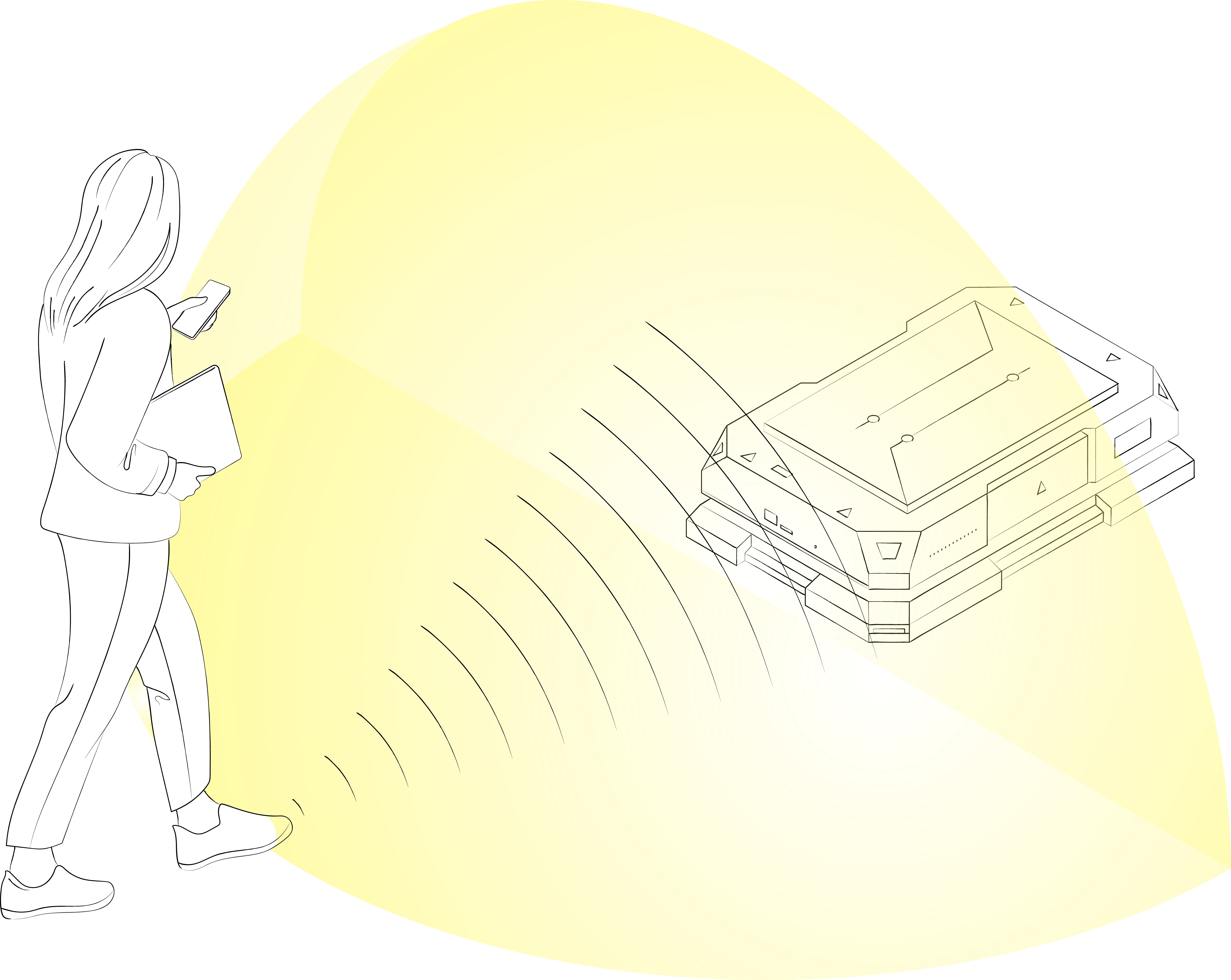
In this article, we’ll explore how ADAR leverages advances in ultrasound technology – from physics and MEMS engineering to signal processing and safety design – to set a new standard for intelligent, safe robotics.
Reading time
Robots and automated systems are moving out of controlled environments and into the real world. Increasingly, they are operating in factories, warehouses, and public spaces; places where safety and perception are critical. Sonair’s ADAR (acoustic detection and ranging) brings true 3D awareness to these machines, making reliable obstacle detection and human safety possible where older sensor technologies fall short.
Unlike legacy sensors that rely on a view in 2D slices, ADAR delivers true 3D obstacle detection and human safety coverage in a compact and cost-effective package. What makes ADAR distinctive is its unique blend of advanced MEMS (micro-electromechanical systems) based hardware, proprietary software for advanced signal processing and beamforming, and a relentless focus on safety – an approach shaped by two decades of Norwegian innovation and a founding philosophy and expertise that’s rooted in real-world industrial safety.
In this article, we’ll explore how ADAR leverages advances in ultrasound technology – from physics and MEMS engineering to signal processing and safety design – to set a new standard for intelligent, safe robotics.
Understanding ADAR’s unique capabilities requires a look at both the fundamental physics of ultrasound and the engineering breakthroughs that make it practical for robotics. This section explores core scientific principles of ultrasound, how Sonair’s innovative MEMS technology hardware harnesses the power of ultrasound for in-air sensing, and finally the advanced proprietary software that brings it all together.
Ultrasound is the term used to describe soundwaves operating at frequencies above 20 kHz, which is commonly defined as the upper limit of human hearing. At its core, ultrasound sensing in air relies on the emission and detection of high-frequency sound waves. When these waves encounter an object, they reflect back as echoes.
Ultrasound has long been one of nature's most sophisticated sensory toolkits. Bats, for example, navigate pitch-black caves at up to 40 mph using 120 kHz chirps in a process called echolocation. As they encounter objects, surfaces, or obstacles, the soundwaves of their chirps bounce back towards them as echoes. These echoes contain information about the distance, size, shape, and texture of its surrounding objects. Ultrasound is critical for safe and efficient navigation and object detection.
Though not identical,there are broad similarities with ADAR that can help understand how it operates. By measuring the time it takes for these echoes to return, and analyzing the minute differences in arrival time across an array of transducers, ADAR can pinpoint not just the distance, but also the direction of obstacles in three-dimensional space.
Ultrasound innovations in the 20th century had enabled sensing in water and human tissue, following the development of ASDIC in 1914 (what is now known as SONAR) and the synthesis of PZT (lead zirconate titanate) in 1952. For a long time, however, ultrasound in-air sensing seemed like a bridge too far.
Historically, the primary obstacle in achieving multi-dimensional air-based ultrasound imaging has been the difficulty of creating miniaturized transducers that are also powerful enough to send sound several meters through air, where energy is quickly attenuated. Making a small transducer is easy; making one that is both small and powerful enough for in-air applications is hard. Additionally, these tiny transducers must be placed close enough together to satisfy the fundamental physical constraint of λ/2 (half-wavelength) spacing, a critical factor that complicates design and manufacturing.
In simple terms, to avoid ambiguous or false detections (often referred to as ghosts) ultrasonic transducers must be spaced no farther apart than half the wavelength of the sound they emit. If this spacing is exceeded, the sensor may incorrectly infer multiple objects at the same distance, which can confuse navigation and safety systems.
ADAR harnesses decades of research and innovation to achieve this balance: creating transducers small enough to meet the demanding λ/2 spacing while also delivering the power needed for practical detection ranges. For an operating frequency of 80 kHz (chosen for its balance of range and spatial resolution in air), this means a spacing of just over 2 mm. Sonair’s MEMS-based technology delivers this precision at scale, setting it apart from traditional, bulkier ultrasound hardware.
High-frequency operation is essential for fine spatial resolution, but it also presents challenges: sound at these frequencies attenuates quickly in air, and generating strong signals from such small transducers requires advanced engineering. Sonair’s MEMS-based hardware makes this possible, enabling dense arrays that were previously out of reach for ultrasound-based in-air sensing solutions.
The hardware foundation of ADAR is the result of a two-decade journey that began at SINTEF MiNaLab in Norway. Early research into piezoelectric micromachined ultrasonic transducers (PMUTs) led to breakthroughs in miniaturization, reliability, and manufacturability. By 2023, Sonair’s team had achieved λ/2-spaced arrays for 80 kHz operation that also generated sufficient power for reliable in-air detection – an industry milestone.
MEMS fabrication allows Sonair to produce transducers that are not only small and powerful, but also highly consistent and scalable. This means ADAR sensors can be manufactured at a fraction of the cost of traditional hand-assembled units, while maintaining the robustness required for industrial and mobile robotics.
Importantly, Sonair’s design philosophy is pragmatic: while certain array geometries might offer theoretical performance gains, the team has prioritized manufacturability, cost, and reliability. The array layout was driven by the need to balance performance with practical constraints like wiring complexity and hardware cost – not by chasing marginal gains in angular precision and signal-to-noise.
ADAR’s advanced software is what transforms its MEMS hardware into a reliable, safety-certified 3D sensor. Sonair’s proprietary firmware handles real-time signal processing and beamforming, enabling fast, accurate obstacle detection and decision-making required to meet high safety standards.
Unlike some legacy systems that attempt to “steer” sound waves or form focused beams, ADAR’s software takes a different approach. It analyzes the echoes received by each transducer to calculate both the range (using time-of-flight) and the direction (using the time difference of arrival across the array). However, what sets ADAR apart from legacy ultrasonic systems is its use of a single, spherical sound wave transmission. This means that all spatial information is extracted from the analysis of this one transmit event, greatly improving the achievable frame rate.
This receive-only method is robust and computationally efficient, allowing ADAR to achieve frame rates up to 50 Hz with minimal latency, which is critical for real-time safety decisions in dynamic environments. What truly distinguishes ADAR’s computational performance is Sonair’s innovative implementation of Fourier-space based algorithms that enable sophisticated signal reconstruction with high efficiency, offering a computational advantage over traditional ultrasound signal processing methods.
Using matched filtering, ADAR’s software compares the frequency profile of each received echo to the precise signature of the emitted pulse, allowing it to reliably distinguish ADAR’s signals from background noise. ADAR emits ultrasound pulses at 80 kHz – a frequency band that is generally less crowded than the 40 kHz range used by many industrial ultrasound devices, such as parking sensors and distance modules. This reduces the risk of interference from other equipment and further enhances the system’s selectivity in complex environments.
Sonair’s software is developed in Rust, a powerful programming language chosen for its unique blend of safety and real-time performance, critical for safety certification. The result is a system that can be trusted not just to detect obstacles, but to do so in a way that meets the stringent requirements of modern robotics safety standards.
When you combine this MEMS-based hardware, advanced software, and safety-driven philosophy, you get a sensor that is robust, certifiable, and ready for real-world deployment. ADAR offers:
ADAR’s capabilities are best understood in the context of real-world robotics challenges. This section highlights why 3D safety is crucial, and how Sonair’s technology is being used today in a variety of demanding environments.
As robots and humans increasingly share workspaces, the limitations of legacy sensing technologies become more apparent. Traditional 2D LiDAR, for example, can only “see” in a single horizontal plane – often missing overhead obstacles, low-lying hazards, or people who aren’t standing upright. ADAR’s 3D coverage ensures that robots can detect obstacles and humans at any height, from floor to ceiling, providing a virtual safety shield that adapts to real-world complexity.
Organizations across industries are already applying ADAR in real-world scenarios. Here are the kinds of contexts in which ADAR is, and can be, highly effective:
These capabilities have already been validated by leading robotics manufacturers. FUJI CORPORATION (Japan) and a Swiss autonomous cleaning robot manufacturer, among several others, have adopted ADAR following comprehensive testing and positive feedback.
As Koji Kawaguchi, General Manager of the Innovation Promotion Department at Fuji, notes: “Thanks to their cooperation, through comprehensive testing, we were able to confirm the high suitability of their sensors for autonomous mobile robots.”
Early access program participants across AMR, industrial, and service robotics sectors have also confirmed ADAR’s effectiveness.
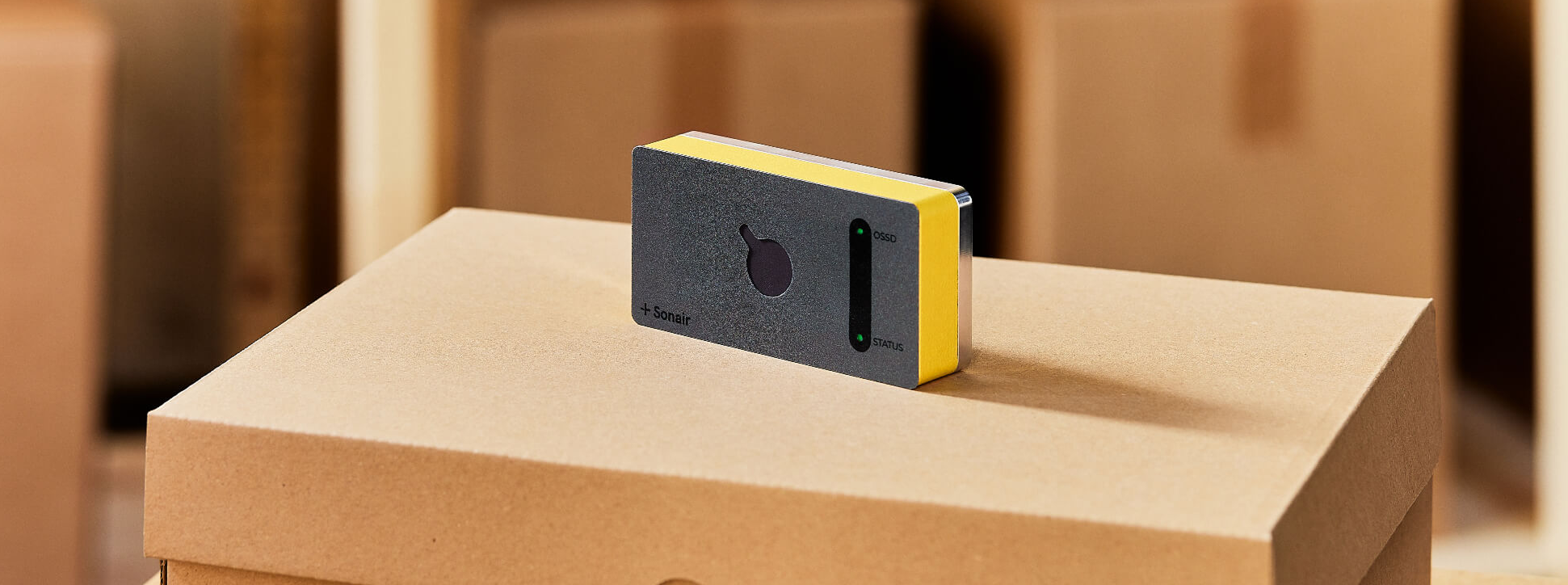
No single sensing technology is perfect, and though there are many applications in which ADAR can excel on its own, there are many scenarios where its strengths are best paired with other complementary solutions. This section addresses some of ADAR’s physical and operational boundaries, and outlines how different sensor combinations can deliver the best results for safety and perception. For a full breakdown of each sensor technology and its strengths and limitations, read our article: Choosing the right sensor technology for your robotics needs.
Ultrasound energy attenuates more quickly in air than light or radio waves, limiting maximum range to around 5 meters in typical conditions. Soft, porous, or highly angled surfaces may absorb or deflect sound, reducing detection reliability. High levels of ultrasonic noise (from pneumatic tools or other sources) can introduce interference, though ADAR’s matched filtering is designed to mitigate this. Environmental factors like temperature and humidity can also affect performance, though ADAR is tested across a wide operational envelope.
Recognizing these realities, Sonair advocates for a sensor combination approach. ADAR is designed to complement other technologies – such as VSLAM (visual simultaneous localization and mapping) for visual mapping or LiDAR for long-range detection. The best results come from smart combinations, leveraging the strengths of each technology to cover the weaknesses of others to suit the environments and contexts that the sensors are operating in.
Safety isn’t an afterthought at Sonair, but a core part of its foundation. This commitment traces back to technology entrepreneur and Sonair CEO Knut Sandven’s earlier journey with GasSecure, where he and his team developed the world’s first wireless optical gas detector for industrial use. Under Knut’s leadership, GasSecure achieved a world first: SIL 2 certification for a wireless gas detector under IEC 61508, setting a new benchmark for reliability and safety in some of the planet’s harshest environments.
Knut and his team learned countless lessons at GasSecure, from the critical importance of certification, to real-world reliability, and designing for the unexpected. These learnings and expertise have been a critical element in the founding of Sonair and development of ADAR. From day one, Sonair’s approach has been oriented towards certification. Safety standards are not simply considered as a goal to be met, but a critical objective that actively shapes the design, engineering, and validation of every sensor. In particular, ADAR has been developed with the explicit goal of meeting some of the highest global safety standards, including IEC 61508, ISO 13849 (performance level d), and SIL2 compliance. This guarantees that every sensor produced not only meets but exceeds regulators’ and customers’ expectations.
This philosophy ultimately allows our technology to be integrated quickly and confidently, reduces risks and liability, and opens doors to markets where safety is non-negotiable. Even in places where certification isn’t legally required, more and more customers and partners expect it and understand the importance of trust and reliability, especially in environments where people share working spaces and facilities with robots. This legacy is why safety isn’t just a feature at Sonair, but a value that shapes every decision, from design to implementation.
As robotics and humans work more closely together, solutions like ADAR are setting new standards for safety and intelligence. To learn more, request an evaluation kit, or discuss how ADAR can be integrated into your robotics platform, contact Sonair today.
What is the angular resolution of your sensor?
This concept is not easily definable with ADAR because a pulse is not sent out in a discrete angle. If you are familiar with LiDARs, angular resolution is the angular distance (in degrees) between distance measurements of 2 beams.
This does not apply to ADAR because it does not emit beams.The angular precision is 2° straight ahead and 10° to the sides. The sensor is able to distinguish between multiple detected objects, if the objects are separated by more than 2 cm in range relative to the sensor or by more than 15° from each other.If the two objects are positioned closer than 2 cm or 15° from each other, they will be detected as 1 object.
Precision is a measure of the statistical deviation of repeated measurements on a single object’s position.
What is the maximum of points you have in the point cloud?
The maximum number of points is very rarely a limitation to the sensor’s performance, because the total number of points needed to fully sense a scene is low. The ADAR technology reports 1 point per surface on any object, making the total number of points low. This is opposite to what one might be used to from LiDARs.
The relative sparsity of the point cloud is a fundamental feature of sound-based sensing, but this is not a sensor limitation as the point cloud will always contain at least 1 point per object within line of sight from the sensor.
Can the sensor distinguish between humans and objects among detected obstacles?
ADAR does not do object classification. The sensor is for people and object detection.

hello@sonair.com
Gullhaug Torg 2D
0484 Oslo
Norway


