
TECH
October 14, 2024
by
Tor Odland
Comparing sensor technologies for mobile robot safety: LiDAR, cameras, ultrasonics
Autonomous mobile robots (AMRs) are transforming industries with their ability to automate material handling, reduce labor costs, and boost efficiency. However, ensuring their safe navigation in dynamic environments is a challenge.
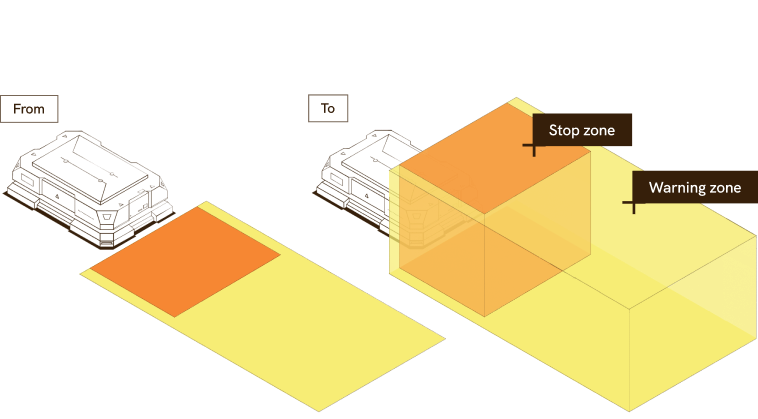
Traditional sensor packages are costly, computationally intensive, and may struggle with certain safety scenarios. In this post, we'll take a closer look at the major sensor technologies used in AMRs, comparing their strengths, weaknesses and costs.
LiDAR (Light Detection and Ranging)
LiDAR is a staple in AMR sensor packages for real-time mapping, obstacle detection, and navigation. However, it's expensive, accounting for approximately 30% of an AMR’s hardware costs. A single LiDAR system can cost around $12,000, while safety-certified 2D LiDARs range from $1,500 to $5,000.
Strengths:
- High-resolution, detailed 2D mapping
- Large field-of-view (FOV) in a single plane
Weaknesses:
- Limited to 2D, making it blind to vertical obstacles
- Expensive and computationally demanding
- Struggles with reflective surfaces, dusty conditions, and dynamic environments
Cameras
Cameras are commonly integrated into AMRs for object recognition and 3D scene understanding. Depth cameras provide 3D environmental data, but they are often used in combination with other sensors due to limitations in safety certification.
Strengths:
- Provides rich visual data for object recognition
- Suitable for AI integration
Weaknesses:
- Affected by lighting conditions (low light, glare)
- Struggles with transparent or reflective objects
- High computational load, leading to latency
1D Ultrasonic sensors
Known for their use in automotive parking systems (like on the bumpers of your car), 1D ultrasonic sensors measure distance to nearby objects. AMRs use them for close-range obstacle detection, but they lack the ability to provide directional information.
Strengths:
- Effective for close-range obstacle detection
- Cost-effective
Weaknesses:
- No directional information
- Limited safety and obstacle detection capabilities
Sonair, based on ADAR: A new category in 3D ultrasonic sensing in air
ADAR (Acoustic Detection and Ranging), the foundation of Sonair’s 3D ultrasonic sensor, offers a new approach by enabling robots to detect obstacles in 3D. Sonair’s ADAR technology significantly reduces costs (50-80% lower than LiDAR) and energy consumption while providing reliable obstacle detection in a 180x180-degree FOV.
Strengths:
- True 3D spatial awareness
- Robust in dusty, reflective, and dynamic environments
- Lower cost and computational demands than LiDAR
Weaknesses:
- Still in early stages of commercialization
Which one should you choose?
As the demand for autonomous mobile robots (AMRs) continues to grow across industries, selecting the right sensor technology becomes critical for ensuring safety, cost-effectiveness, and operational efficiency. Traditional sensors like LiDAR and cameras provide high-resolution data but come with significant drawbacks, including high costs, computational demands, and performance limitations in challenging environments. Basic, 1D ultrasonic sensors offer low-cost, close-range detection but lack directional capabilities and advanced safety features.
Emerging technologies, such as ADAR (Acoustic Detection and Ranging) with Sonair’s 3D ultrasonic sensor, provide a promising alternative. With true 3D spatial awareness, ADAR not only enhances safety but also reduces costs and energy consumption. Although it is still in the early stages of commercialization, its robust performance in diverse environments and lower overall system demands make it a compelling option for future AMR deployments. By leveraging these evolving technologies, companies can ensure safer, more efficient operations at a fraction of the cost.
Interested in joining our Early Access Program? Reach out.


hello@sonair.com
Gullhaug Torg 2D
0484 Oslo
Norway
