
NEWS
September 29, 2026
by
Sonair team
What it takes to make humanoid robots safe around people
Humanoid robots have to perceive people at every height, not in a single scan plane. In an interview with ROBOTIK UND PRODUKTION, Sonair CEO Knut Sandven explains what 3D ultrasonic sensing adds, and what it will take to make it work on humanoids.
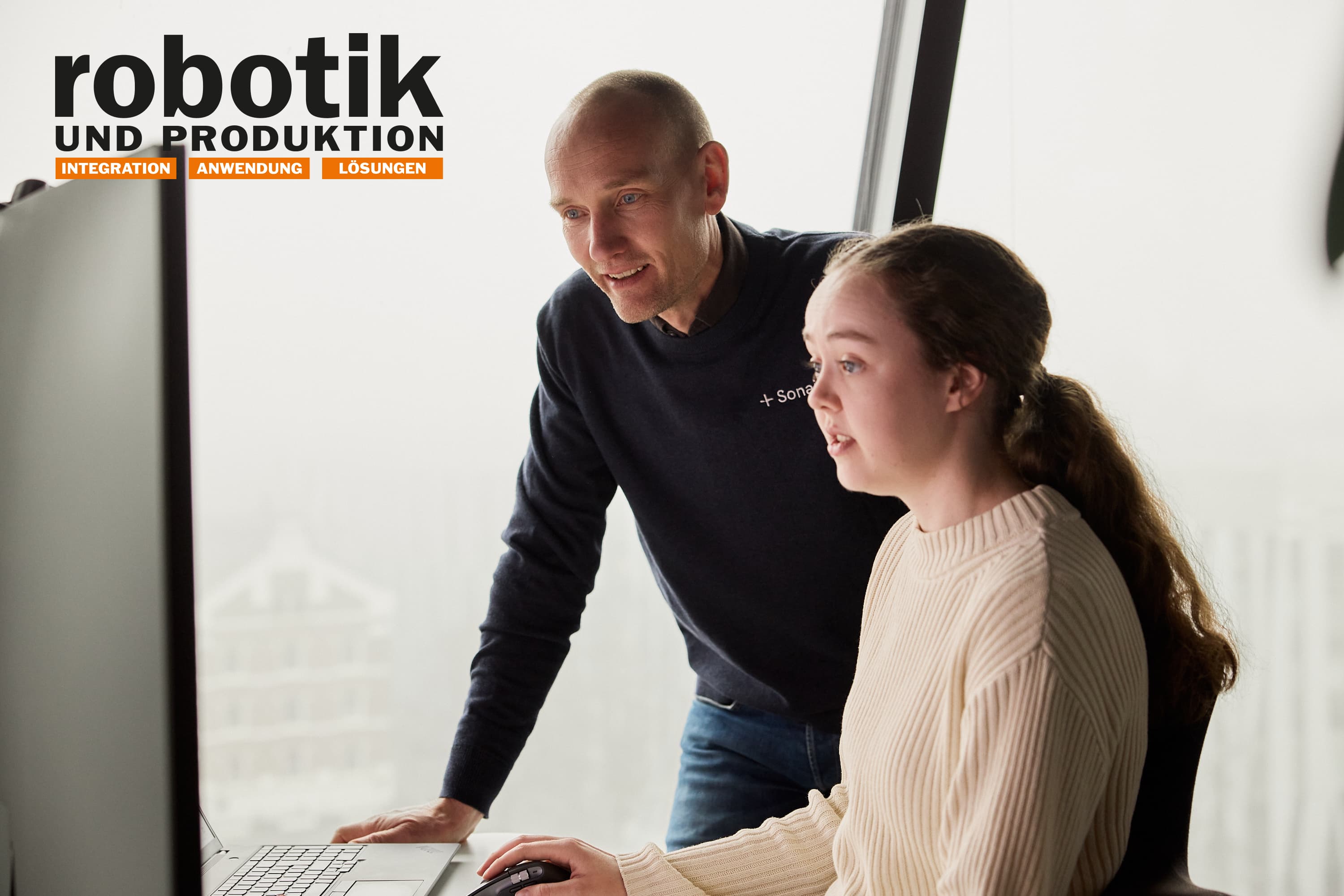
A humanoid robot doesn't work in a single plane. It reaches, bends and turns among people who do the same. That puts perception at the centre of making humanoids safe to work beside.
In its October issue on humanoid robotics, ROBOTIK UND PRODUKTION asked Sonair CEO Knut Sandven what 3D sensing brings to humanoids, AMRs and industrial robots. Below is a shortened English version. Read the full interview (in German).
How did you extend safety-rated perception to the full three-dimensional space?
The core limitation of 2D lidar isn't intelligence, it's geometry. A rotating laser only sees one horizontal plane. Anything above or below it is effectively invisible, however good the software is. So we had to solve it in hardware first.
We developed tiny MEMS ultrasonic transducers, placed closely enough together to work as one array. The principle is similar to medical ultrasound: send out sound, capture the echoes, build an image. We just do it through air instead of tissue.
SIL 2 / PL d wasn't added at the end. Safety requirements shaped the design from the start, from how the elements are arranged to writing the firmware in Rust, since IEC 61508 and ISO 13849 require deterministic real-time behaviour.
Where does 3D ultrasound add the most value over 2D laser scanners?
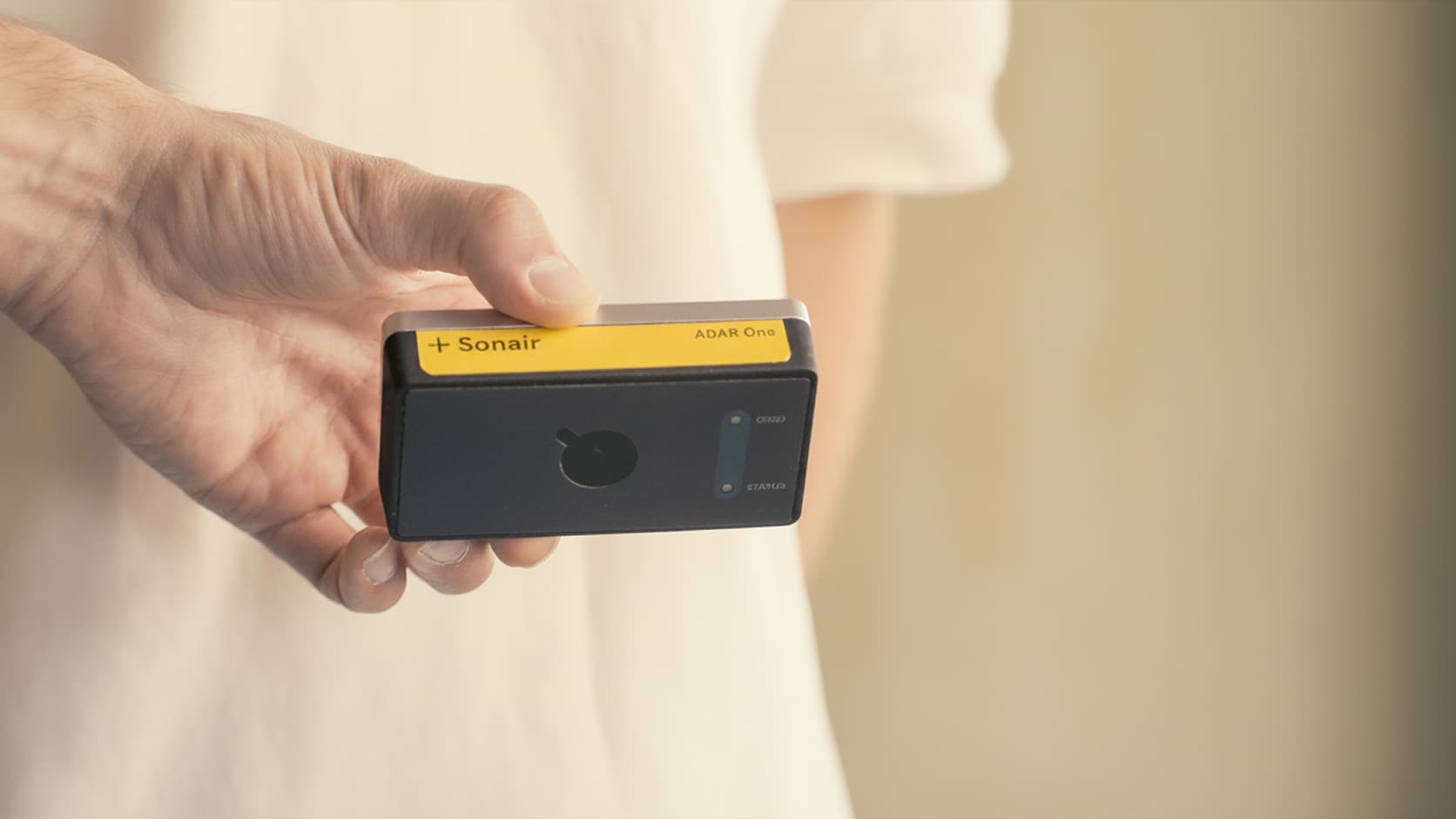
Low and overhanging obstacles. Forklift tines, pallets, dropped tools, low shelving and overhanging loads can all sit outside a 2D scanner's plane. So can a person who is crouching or sitting. With 180 × 180° coverage, ADAR One detects people and objects across their full height.
Ultrasound is also largely unaffected by dust, moisture, glass and mirrors, which cameras and lidar can misread or miss. Cleanfix saw fewer false stops in dusty and wet cleaning environments. On the Cleanfix RA660 Navi XL, a single ADAR One replaces up to 14 separate linear ultrasonic sensors, which means less cabling, fewer failure points and true 3D coverage. It can also be used in stationary robot cells to create distance-based, dynamic safety zones.
How does 3D sensing improve human-robot collaboration and fleet operation?
It moves you from avoidance zones to real spatial understanding. A fleet that sees one plane needs large margins and abrupt stops, because it can't tell whether an overhanging object is actually in its path. Full 3D perception lets robots move more smoothly and predictably around people, with fewer unplanned stops.
It also allows graduated responses. A robot can slow down instead of stopping outright, because it can tell an object in a warning zone from a real intrusion into the stop zone. ADAR One supports a stop zone and warning zones across up to 128 preconfigured zone sets. That makes robot behaviour easier for people to read, and more consistent across larger fleets.
Which 3D sensing approaches are most promising for humanoids?
No single technology will be enough. A humanoid has to perceive its whole workspace, at every height. That means combining optical sensing, such as cameras and lidar, with non-optical methods like radar and ultrasound. Cameras and visual SLAM can support semantic understanding of the environment, while 3D ultrasound serves as the safety-critical layer in the near field.
Functional safety matters here too. ADAR One is currently the only one of these approaches available as a certified, ready-to-use 3D sensor. With uncertified components, the robot maker has to prove safety at system level themselves. That takes functional safety expertise, and changes to the safety architecture can trigger recertification.
What makes real-time processing of 3D sensor data hard?
Cameras and 3D lidar generate large volumes of data, which is often downsampled or compressed on the device. That risks losing exactly the details that matter. For a safety function, we don't think that works: the information you need to guarantee a stop can't be compressed away.
Ultrasound avoids the problem by design. ADAR One delivers a sparse point cloud focused on the nearest points, the ones that matter for safety, so there is little data to process in the first place. And because it needs no semantic recognition, it doesn't face the trade-off AI-based perception has with unusual, out-of-distribution situations.
What will make 3D sensing cheaper and more reliable for humanoids?
It's a chicken-and-egg problem. Humanoid production is still in the tens of thousands, not millions. As volumes grow, sensing becomes a smaller share of total component cost. Because our sensors are MEMS-based, the manufacturing process is inherently a volume technology, consistent and scalable in a way hand-assembled arrays are not.
Form factor is the second lever. In our evaluation kit, the transducers measure 9 × 9 × 2.5 cm. Longer term, instead of one large sensor module, many small elements could be distributed across a humanoid's outer shell, much like an array of tiny microphones, giving all-round coverage without a large central housing.
First published in German in ROBOTIK UND PRODUKTION, issue 5 (October) 2026, in the magazine's humanoid robotics focus section, and online on 25 September 2026. Questions by editor-in-chief Frauke Itzerott. Translated and shortened by Sonair. Read the original article.

hello@sonair.com
Gullhaug Torg 2D
0484 Oslo
Norway
